
In 2013, a Reuters investigation and a parallel Tampa Bay Times investigation exposed a quiet practice running through tens of thousands of new home sales: D.R. Horton, the largest homebuilder in the United States, had been severing the mineral rights from properties it sold across 14 states. In Florida alone, the Fort Worth, Texas company had kept the rights under more than 10,000 lots. Most buyers never realized it. One couple in Brandon, Florida told the Tampa Bay Times they learned about the severance in the final minutes of their closing and felt they had to sign or lose the deal. After the reporting, Horton agreed to return rights to roughly 700 homeowners in North Carolina and suspended the practice in Florida while offering to return rights to affected buyers there as well.
[^1] [^2]
The Horton story is dramatic because it was systematic and hit so many buyers at once. But it is not unusual. Severed mineral estates are the most misunderstood concept in American real estate, and they are not just a rural problem. They show up under suburban subdivisions, commercial buildings, shopping centers, and golf courses. The deed you signed transferred whatever the seller owned, and in much of the country, what the seller owned was the surface only.
The split estate, explained
Real property in the United States can be divided into two estates: the surface estate (the land, the buildings, the trees, ordinary use) and the mineral estate (oil, gas, coal, hard rock minerals, and other subsurface resources). These can be owned together (a "unified estate") or separately (a "severed estate"). Once severed, they typically stay severed. A mineral estate can be inherited, divided, sold, leased, and sold again, all without notifying the surface owner.
In most producing states, the mineral estate is treated as legally dominant, giving mineral owners broad rights to use the surface. The mineral owner can access the surface to extract their minerals, even if you object. They have to compensate you for surface damage and follow setback rules, but they do not need your permission to drill.
Where this matters most
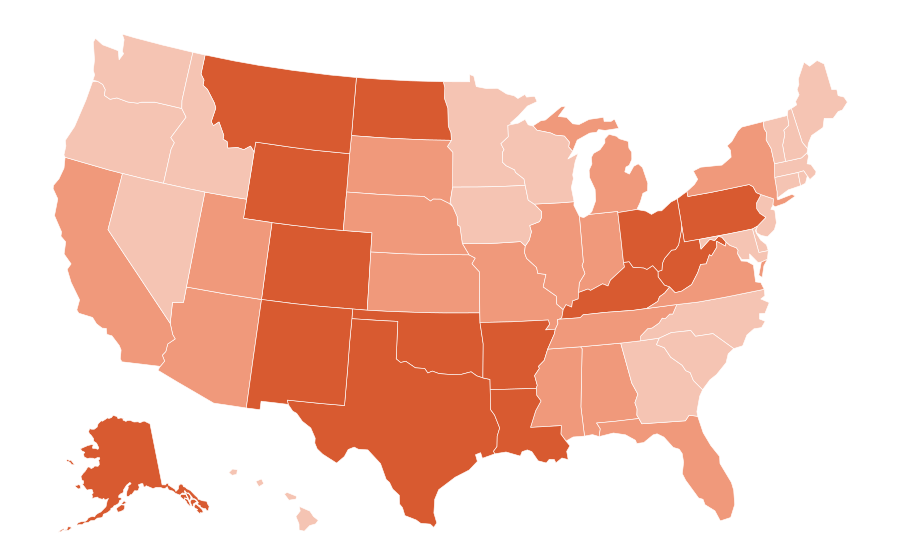
Severance prevalence varies dramatically by region. In some states, mineral severance is almost universal in resource areas. In others, most buyers will never encounter it.
This map is a practical risk guide, not a precise prevalence survey. It highlights where split estates are common enough that buyers and investors should actively check mineral title.
High prevalence states, where buyers should specifically check for severance: Texas, Oklahoma, Louisiana, New Mexico, North Dakota, Pennsylvania, West Virginia, Ohio, Colorado, Wyoming, Montana, Kentucky, Arkansas, and Alaska. Within these states, severance is common in oil, gas, and coal regions; urban and non-resource counties may have far fewer severed estates. Even so, real estate professionals in these states typically treat severance as the baseline assumption rather than the exception.
Regional pockets within otherwise low risk states. Southwest Virginia coal country (Buchanan, Wise, Dickenson, Russell, and Tazewell counties) is a clear example. Severance there often goes back more than a century to coal company purchases. The rest of Virginia is largely unaffected. The same caveat applies to California (Central Valley vs. coast), New York (Southern Tier vs. NYC), Tennessee (Cumberland Plateau vs. rest), Michigan (Antrim Shale region), and Florida (where the D.R. Horton situation introduced builder severance into otherwise unaffected counties).
Low prevalence regions. New England, most of the Mid Atlantic outside Pennsylvania, most of the Southeast outside coal country, the upper Midwest, the Pacific Northwest, and Hawaii. Buyers in Richmond, Charlotte, or Boston rarely encounter severed mineral estates. Buyers in Wise County, Virginia or Williamson County, Texas should expect to.
State law also varies in ways that matter. Texas law strongly favors the mineral estate. Pennsylvania law is more protective of surface owners. Virginia law includes a statutory presumption that minerals do not exist on a parcel if the claimed mineral interest has gone unused and untaxed for 35 years, but the presumption does not apply west of the Blue Ridge Mountains, which is where the coal severance actually lives. Some states have force pooling laws that compel your minerals into a drilling unit even if you refuse a lease. Some require strict setback distances from occupied structures. Some do not.
The takeaway: do not assume "I have not heard of this in my area" means it does not exist. Check the county.
How to find out what you actually own
There is no national database. Determining ownership requires running the chain of title.
Read your deed. Look for language like "reserving and excepting all oil, gas, and other minerals" or "together with all mineral rights." If your deed reserves minerals to the seller, you did not buy them.
Check the title commitment. Schedule B will list mineral reservations as exceptions. Most buyers skim this section. Do not.
Order a mineral title opinion. For a definitive answer, a landman or real estate attorney runs a mineral chain of title back to the original severance. In active extraction regions, this is routine and runs roughly 500 to 2,000 dollars depending on complexity.
Check state oil and gas records. Texas, Oklahoma, North Dakota, Colorado, and other active states publish lease, well, and production data tied to specific parcels.
What it actually means for you
The practical impact depends on whether minerals are dormant, leased, or producing.
If you own unified rights and minerals are dormant, nothing changes today. If they are actively producing, you receive royalty payments, typically 12.5 to 25 percent of production value, depending on lease terms.
If minerals are severed and dormant, status quo holds, but a future lease and surface use is always possible. This is the scenario surface owners forget about, then get blindsided by when activity starts.
If minerals are severed and producing under your property, the operator has the right to use reasonable surface area for extraction. You have no royalty interest. You have a legal right to compensation for surface damage, but you do not control whether or where activity occurs.
The difference between owning producing minerals and not owning them is the difference between getting paid for activity on your property and watching it happen for free.
Buildings and commercial property
For investors buying buildings rather than raw land, mineral rights matter less often, but more catastrophically when they do. A multifamily property in an active region can have a producing well 200 feet from a building. A subdivision developer can build out a project only to find an operator wants to drill on the cul-de-sac. If you are buying in a state with active resource extraction, mineral title belongs on your due diligence checklist regardless of property type.
Quick checklist
Before closing, confirm:
- You know whether you are buying unified rights or surface only
- You have read the deed language transferring the property to you
- You have read every mineral reservation in the title commitment
- You have ordered a mineral title opinion if the situation is unclear
- You understand the surface use rights of any existing mineral lease
- You have checked state oil and gas records for nearby activity
You do not need to walk away from every property with severed minerals. Most never produce. The point is to know what you own, what you do not own, and what could happen on your property without your permission, before you commit capital to it.
Sources
[^1]: Builders Secretly Hoard Mineral Rights Under Property — Reuters / CNBC, 2013-10-09 [^2]: Homebuilder D.R. Horton will no longer pocket mineral rights — Tampa Bay Times, 2013-10-26